
Age
An age card with "over 16: yes" and "over 18: yes" lets a shop check your age without ever seeing your date of birth.
Bisotun Wallet is built around selective disclosure: sharing only the specific facts a service asks for, instead of a whole document. Here is what that means in practice, what each party sees, and where the limits are.
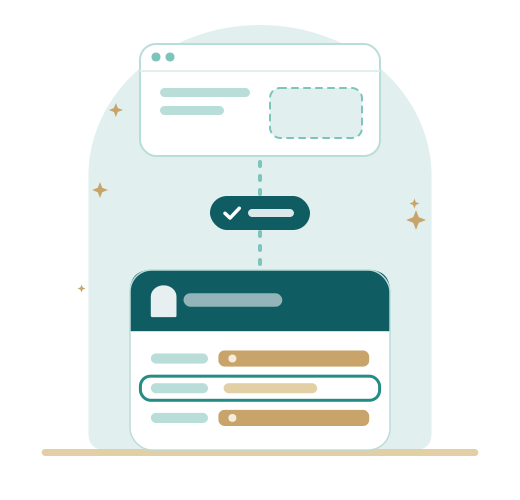
Imagine your university has issued you a diploma card with five items on it:
A job portal asks for institution and degree. Your wallet shows you exactly those two items and asks whether you want to share them. You tap Share.
| What the job portal receives | What it does not receive |
|---|---|
| Institution and degree | Your name, date of birth and grade |
| Proof that the university signed these values | A copy of the certificate or the rest of the card |
| Card type and issuer ("Diploma card from your university") | Any other card in your wallet |
| The week the card was issued and the week it expires | Your PIN, your wallet's account ID |
If the portal also needs your name, it has to ask for it, and you see that before deciding. The proof still shows that all the shared items come from the same genuine card.
(The diploma card is an illustration. Such cards appear when universities issue them on Bisotun; today each existing card holds a single item, so the "part of a card" benefit shows once richer cards are issued.)
Selective disclosure works on the items an issuer puts on the card. So the most privacy-friendly cards contain ready-made answers:
An age card with "over 16: yes" and "over 18: yes" lets a shop check your age without ever seeing your date of birth.
"Enrolled: yes" plus the institution is enough for a student discount. Name and student number stay on your phone.
"Member level: gold" gets you the partner offer. Your member number stays private.
Bisotun cannot calculate "over 18" from a date of birth at the moment you share; the issuer includes such answers on the card. These cards are examples of what organizations can issue.
An online shop asks: “Are you over 18?”
The shop receives only this
Over 18: yes
Issuer signature valid
Every time you show a card, your wallet creates a new, randomized proof. Two services, or the same service on two occasions, cannot tell from the proof itself that it came from the same card.
Be aware of what can still connect you:
Bisotun is private, not anonymous: what you choose to share can identify you.
We think you should know exactly what passes through our servers.
Cards and their contents are stored on your phone only. There is no central database of your cards and no cloud copy.
To protect your wallet, a part of every proof is made together with our keyshare server after it checks your PIN. It therefore records that and when your wallet was used and your PIN checks. It does not learn what you shared or with whom. You can view this log in My Bisotun.
Our session server checks each proof on behalf of the website and passes the verified result on. It therefore handles the values you share, keeps the result in memory for up to five minutes so the website can collect it, and does not keep a record of what you shared.
Using a card does not contact the organization that issued it. Your university does not learn where you show your diploma.
The app itself contains no advertising, no crash reporting and no analytics or tracking. It connects only to Bisotun's servers and to the service you are sharing with. Screens are hidden from screenshots and from the app switcher unless you change that in Settings.
Any website can send a request to your wallet. Bisotun does not yet verify the names of organizations, so every requester is shown by its web address, with a notice that it is not a known organization. Check that address before you share, just as you would check the address bar before typing a password.
Privacy you can check for yourself.